
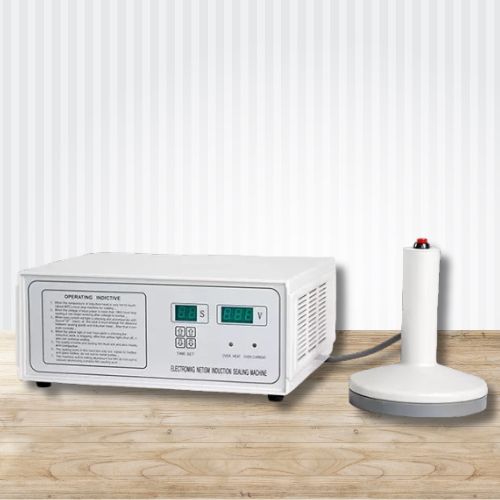

No.1 Manual Induction Sealing Machine
| Model Number | CP-130 MS |
| Voltage(V/Hz) | AC 220/50 |
| Sealing Power (kW) | 600 W |
| Heal Diametre(mm) | 20-130 |
| Grade | Manual |
| Capacity | 0-50 pc/min |
| External Dimension(LxWxH) | 340x290x150 (mm) |
| Net Weight (Kg) | 5 Kg Approximate |
Product Description
A Manual Induction Sealing Machine
is a device used for applying an induction seal to the top of containers or bottles to provide tamper-evidence and prevent leakage. Induction sealing is a common method used in the packaging industry to create a secure seal on various types of containers. Here are key features and aspects associated with a Manual Induction Sealing Machine:
- Manual Operation:
- Requires manual operation, where an operator places the sealing head over the container and initiates the sealing process.
- Induction Sealing Technology:
- Utilizes induction heating technology to create a hermetic seal between the lid and the container. This involves applying a special foil liner to the container’s cap, and then using electromagnetic induction to heat the foil, causing it to bond with the container.
- Handheld Sealing Head:
- Typically equipped with a handheld sealing head that is pressed onto the container’s cap to initiate the sealing process.
- Portable and Compact:
- Designed to be portable and compact, making it suitable for smaller production environments or applications with limited space.
- Adjustable Power Settings:
- Offers adjustable power settings to accommodate different container materials, sizes, and foil liners.
- Quick Sealing Process:
- Provides a quick sealing process, contributing to efficiency in small-scale production or manual packaging operations.
- Tamper-Evident Seals:
- Creates tamper-evident seals, ensuring the integrity of the product and providing consumers with confidence in the product’s safety.
- Versatility:
- Suitable for sealing various types of containers, including plastic bottles, glass jars, and other materials commonly used in the food, pharmaceutical, and cosmetic industries.
- Low Maintenance:
- Typically requires low maintenance, with simple cleaning procedures to maintain the machine’s performance.
- Indication Lights:
- May include indication lights to signal the completion of the sealing process or to alert operators to any issues.
- User-Friendly Controls:
- Equipped with user-friendly controls, often featuring a simple interface for ease of use.
- Single Seal or Continuous Sealing:
- Depending on the model, it may offer the capability for single-seal applications or continuous sealing for higher production speeds.
- Applications:
- Commonly used in industries such as food and beverage, pharmaceuticals, and cosmetics for sealing products that require tamper-proof packaging.
- Affordability:
- Generally more affordable compared to automated induction sealing machines, making it a cost-effective choice for smaller businesses.
- Seal Quality:
- Provides reliable and consistent seal quality to protect the contents of the containers.
Manual Induction Sealing Machines are suitable for businesses with lower production volumes or those looking for a cost-effective and manual sealing solution. They offer the advantages of tamper-evident seals and leak prevention, contributing to product safety and quality.