
Flat Bottle Labeling Machine (Pneumatic Type)
If your production line handles bottles, cartons, boxes, or any container with a flat surface, you already know that labeling is one of the trickiest steps to get right. Curved bottles have their own labeling solutions, but flat-sided containers — think rectangular bottles, cosmetic tubes, flat-panel cartons, or square jars — need a different approach. That’s where a pneumatic flat bottle labeling machine comes in.
In this guide, we’ll break down exactly what this equipment is, how it works, why manufacturers across industries are switching to pneumatic labeling systems, and what to look for before you buy one.
What Is a Pneumatic Flat Bottle Labeling Machine?
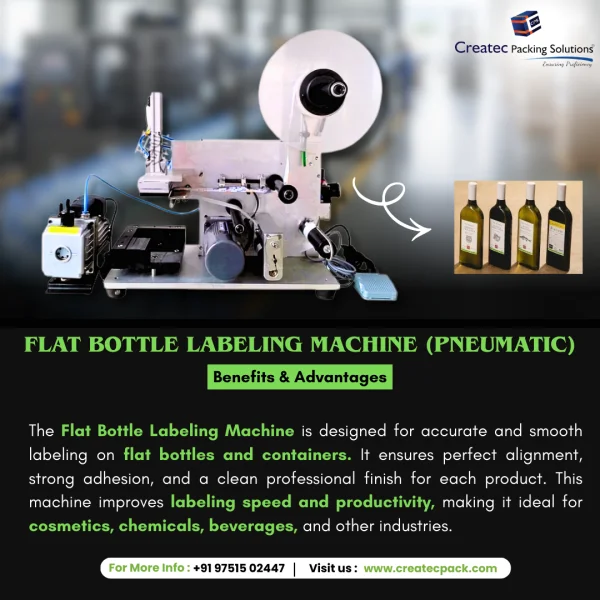
A pneumatic flat bottle labeling machine is an automated or semi-automated labeling system designed specifically for applying labels to flat or slightly curved surfaces. Unlike wrap-around labelers built for round bottles, this type of machine uses compressed air (pneumatics) to power the label application mechanism — typically a tamp-blow or tamp-pad system that presses the label firmly and evenly onto the flat face of a container.
The “pneumatic” part refers to how the machine actually applies the label: instead of relying purely on mechanical rollers or servo motors, it uses an air cylinder to extend a pad or applicator, position the label precisely, and press it onto the product with consistent, repeatable pressure. This makes pneumatic systems especially good at handling delicate, irregular, or hard-to-reach flat surfaces where a smooth, bubble-free finish matters.
How a Pneumatic Bottle Labeling Machine Works
While designs vary by manufacturer, most pneumatic flat bottle labeling machines follow a similar sequence:
- Label dispensing – A roll of pressure-sensitive labels feeds through a peel plate, which separates the label from its liner as it moves.
- Vacuum or tamp pad pickup – The exposed label is picked up by a pad, often using vacuum suction to hold it in place.
- Pneumatic actuation – A pneumatic cylinder extends the pad toward the product at a controlled speed and force.
- Application – The label is pressed onto the flat surface of the bottle, carton, or container with even pressure, eliminating wrinkles or air bubbles.
- Retraction and reset – The pad retracts, and the cycle repeats for the next unit, either manually triggered or synchronized with a conveyor via a photoelectric sensor.
This tamp-blow or tamp-press cycle typically takes less than a second, which is why pneumatic labelers are popular for both mid-volume production lines and manual workstations that need a productivity boost.
Why Choose Pneumatic Labeling Over Other Systems?
There are several labeling technologies on the market — mechanical roller labelers, servo-driven systems, and pneumatic tamp applicators among them. Here’s why pneumatic machines remain a strong choice for flat-surface labeling specifically:
1. Precision on Flat and Recessed Surfaces
Pneumatic tamp systems excel at reaching into recessed panels or applying labels to surfaces that a wrap-around roller simply can’t access cleanly.
2. Consistent Pressure, Fewer Defects
Because the air cylinder delivers a controlled, repeatable force, every label goes on with the same pressure — reducing wrinkles, misalignment, and peeling issues that often plague manual labeling.
3. Lower Cost of Entry
Compared to fully servo-electric labeling systems, pneumatic machines are generally more affordable to purchase and maintain, making them attractive for small and mid-sized manufacturers.
4. Simple Maintenance
Pneumatic components (cylinders, valves, air lines) are mechanically simple and widely available, which usually means lower long-term maintenance costs and less downtime compared to more complex servo or robotic systems.
5. Flexibility Across Container Types
Many pneumatic flat labeling machines can be adjusted to handle a range of bottle widths, heights, and label sizes, making them a good fit for facilities that run multiple SKUs.
Industries That Use Flat Bottle Labeling Machines
Pneumatic flat labeling machines are used well beyond just beverage bottles. Common applications include:
- Cosmetics and personal care – flat-sided cream jars, serum bottles, and compact cases
- Pharmaceuticals and nutraceuticals – supplement bottles, blister card backers, and flat vials
- Food and beverage – flat juice bottles, sauce bottles, and rectangular packaging
- Household and industrial chemicals – cleaning product bottles and flat containers
- Electronics and consumer goods – flat-panel boxes and product casings
If your product has at least one flat face large enough to hold a label, this type of machine is worth considering.
Key Features to Look for When Buying
Not all pneumatic flat bottle labeling machines are built the same. When comparing options, keep these factors in mind:
- Labeling speed – Measured in labels per minute; match this to your production line’s throughput needs.
- Label size range – Confirm the machine can handle both your current label dimensions and any future packaging changes.
- Sensor accuracy – Photoelectric or fiber-optic sensors determine how precisely the label is positioned; higher-end sensors reduce misapplication.
- Air supply requirements – Check the required PSI and air volume, and make sure your facility’s compressor can support it.
- Changeover time – Look for tool-free or quick-adjust mechanisms if you run multiple product sizes.
- Integration options – Some machines can be integrated into an existing conveyor line, while others operate as standalone semi-automatic units.
- Build quality – Stainless steel frames and food-grade components matter if you’re in food, beverage, or pharma.
Semi-Automatic vs. Fully Automatic Pneumatic Labelers
Buyers often have to choose between:
- Semi-automatic pneumatic labelers – An operator manually places the bottle, and the machine handles label pickup and application at the push of a button or foot pedal. Ideal for lower volumes or businesses scaling up from manual labeling.
- Fully automatic pneumatic labeling systems – Integrated with a conveyor and sensors, these machines detect, label, and move products through without operator intervention at each step. Better suited for higher-volume production lines.
If you’re currently labeling by hand or considering your first piece of labeling equipment, a semi-automatic pneumatic machine is often the most practical entry point — it delivers a major efficiency and consistency improvement without the cost or footprint of a fully automated line.
Common Questions About Pneumatic Flat Bottle Labeling Machines
Is a pneumatic labeling machine hard to operate?
No. Most semi-automatic pneumatic labelers are designed for simple operator use — load the label roll, place the bottle, and trigger the cycle. Training typically takes minutes, not days.
What air pressure is needed?
Requirements vary by machine, but many pneumatic labeling systems run on standard shop air in the 4–6 bar (60–90 PSI) range. Always confirm the manufacturer’s specification against your facility’s compressed air supply.
Can one machine handle different bottle sizes?
Many models offer adjustable guides and sensor settings to accommodate a range of bottle widths and label sizes, though very different container shapes may require a fixture change.
How much space does it take up?
Semi-automatic units are typically compact enough for a tabletop or small workstation footprint, while fully automatic inline systems require more floor space to accommodate the conveyor.
Ready to Upgrade Your Labeling Process?
A pneumatic flat bottle labeling machine can eliminate the inconsistency of manual labeling, reduce product waste from misapplied labels, and free up staff time for higher-value tasks — all without the investment required for a fully robotic labeling line.
If you’re evaluating options for your production line, our team can help you match the right machine specs — speed, label size range, air requirements, and automation level — to your specific product and volume needs.